What Happens to the Reflected and Refracted Rays as You Change the Angle of the Incident Light Beam?
The Constabulary of Reflection and Its Consequences
The law of reflection states that the angle of reflection equals the angle of incidence.
Learning Objectives
Formulate the relationship betwixt the angle of reflection and the angle of incidence
Primal Takeaways
Central Points
- Light strikes dissimilar parts of a rough surface at different angles and is reflected, or diffused, in many different directions.
- A mirror has a smooth surface (compared with the wavelength of light) and so reflects light at specific angles.
- Nosotros see the calorie-free reflected off a mirror coming from a direction adamant by the police of reflection.
Central Terms
- reflection: the property of a propagated wave being thrown dorsum from a surface (such as a mirror)
Whenever y'all look into a mirror or squint at sunlight glinting off a lake, you are seeing a reflection. When you look at the text in a book, you lot are actually seeing the light that is reflected from it. Big telescopes use reflections to form images of stars and other astronomical objects. In fact, the only way we can see an object that does non itself emit light is if that object reflects light.
The law of reflection is illustrated in, which also shows how the angles are measured relative to the perpendicular to the surface at the point where the light ray strikes. The law of reflection is very simple: The angle of reflection equals the angle of incidence. When we see our reflection in a mirror, it appears that our image is actually behind the mirror — we see the light coming from a direction determined by the law of reflection. The angles are such that our image appears exactly the same distance behind the mirror every bit nosotros stand away from the mirror.
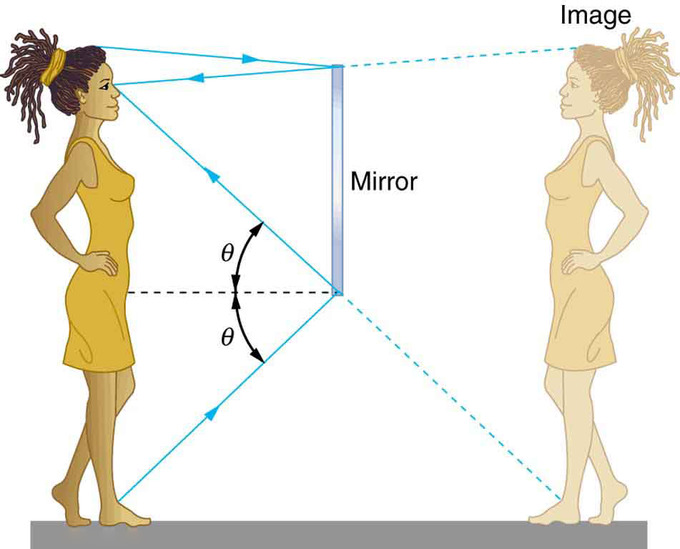
Mirror Reflection: An prototype in a mirror appears every bit though information technology is behind the mirror. The two rays shown are those that strike the mirror at just the correct angles to be reflected into the eyes of the viewer. The image appears to come from the direction the rays are coming from when they enter the viewer's eyes.
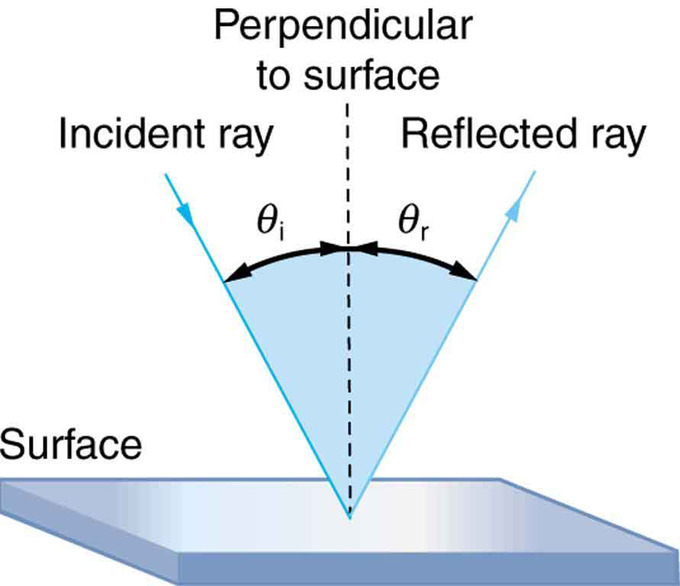
Constabulary of Reflection: The law of reflection states that the angle of reflection equals the angle of incidence: θr = θi. The angles are measured relative to the perpendicular to the surface at the indicate where the ray strikes the surface.
We wait to see reflections off a shine surface. However, light strikes different parts of a rough surface at unlike angles, and information technology is reflected in many different directions ("diffused"). Diffused light is what allows usa to encounter a sheet of newspaper from whatever angle. Many objects, such every bit people, clothing, leaves, and walls, have crude surfaces and tin can be seen from all sides. A mirror, on the other mitt, has a polish surface (compared with the wavelength of light) and reflects light at specific angles. When the moon reflects off the surface of a lake, a combination of these effects takes place.
The Police of Refraction: Snell's Law and the Index of Refraction
The corporeality that a lite ray changes its management depends both on the incident angle and the amount that the speed changes.
Learning Objectives
Formulate the relationship between the index of refraction and the speed of light
Key Takeaways
Cardinal Points
- The irresolute of a calorie-free ray's direction (loosely called bending) when it passes through variations in matter is chosen refraction.
- The index of refraction is due north=c/five, where 5 is the speed of light in the material, c is the speed of calorie-free in vacuum, and n is the alphabetize of refraction.
- Snell's constabulary, the law of refraction, is stated in equation class every bit [latex]\text{northward}_1\sin{θ_1}=\text{n}_2\sin{θ_2}[/latex].
Cardinal Terms
- refraction: Irresolute of a calorie-free ray'south direction when it passes through variations in matter.
- alphabetize of refraction: For a cloth, the ratio of the speed of light in vacuum to that in the material.
Information technology is easy to observe some odd things when looking into a fish tank. For instance, you may come across the same fish appearing to be in 2 different places. This is because light coming from the fish to u.s.a. changes direction when information technology leaves the tank, and in this instance, it tin travel ii dissimilar paths to get to our optics. The changing of a calorie-free ray'south direction (loosely chosen bending) when it passes through variations in matter is called refraction. Refraction is responsible for a tremendous range of optical phenomena, from the action of lenses to voice transmission through optical fibers.
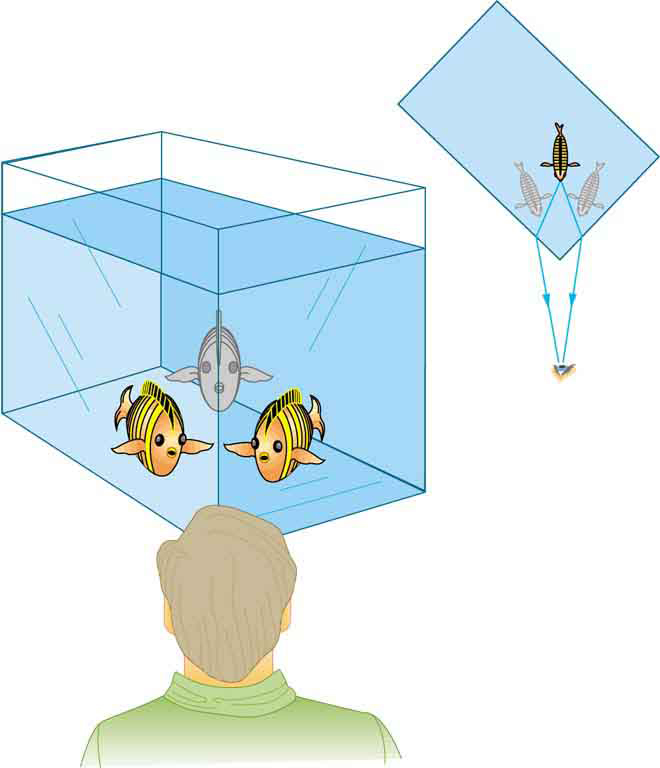
Law of Refraction: Looking at the fish tank as shown, we tin can see the same fish in two dissimilar locations, because light changes directions when it passes from h2o to air. In this case, the light can attain the observer by two unlike paths, and and then the fish seems to exist in two unlike places. This angle of light is called refraction and is responsible for many optical phenomena.
Refraction: The irresolute of a lite ray's management (loosely chosen bending) when information technology passes through variations in matter is called refraction.
Speed of Low-cal
The speed of low-cal c not just affects refraction, information technology is ane of the primal concepts of Einstein's theory of relativity. The speed of light varies in a precise mode with the material it traverses. Information technology makes connections between space and time and alters our expectations that all observers measure the same time for the aforementioned event, for instance. The speed of calorie-free is and so important that its value in a vacuum is one of the most fundamental constants in nature as well as existence 1 of the 4 key SI units.
Why does light change direction when passing from one material ( medium ) to another? It is because light changes speed when going from i material to another.
Law of Refraction
A ray of light changes direction when information technology passes from one medium to another. Equally before, the angles are measured relative to a perpendicular to the surface at the signal where the light ray crosses it. The change in direction of the light ray depends on how the speed of light changes. The change in the speed of light is related to the indices of refraction of the media involved. In mediums that have a greater index of refraction the speed of light is less. Imagine moving your hand through the air and then moving it through a body of h2o. Information technology is more difficult to motion your hand through the water, and thus your hand slows downwardly if y'all are applying the same amount of strength. Similarly, light travels slower when moving through mediums that have higher indices of refraction.
The amount that a light ray changes its direction depends both on the incident angle and the amount that the speed changes. For a ray at a given incident angle, a large modify in speed causes a big alter in direction, and thus a big alter in angle. The exact mathematical relationship is the police of refraction, or "Snell's Law," which is stated in equation form equally:
northward1sinθi = n2sinθ2
Hither n1 and due north2 are the indices of refraction for medium ane and 2, and θi and θ2 are the angles betwixt the rays and the perpendicular in medium 1 and two. The incoming ray is called the incident ray and the approachable ray the refracted ray, and the associated angles the incident angle and the refracted angle. The law of refraction is also called Snell's law after the Dutch mathematician Willebrord Snell, who discovered it in 1621. Snell's experiments showed that the police force of refraction was obeyed and that a characteristic index of refraction northward could be assigned to a given medium.
Total Internal Reflection and Fiber Optics
Total internal reflection happens when a propagating moving ridge strikes a medium purlieus at an angle larger than a particular disquisitional angle.
Learning Objectives
Formulate conditions required for the total internal reflection
Fundamental Takeaways
Key Points
- The critical bending is the angle of incidence above which total internal reflection occurs and given equally [latex]\theta_\text{c} = \arcsin \left( \frac{\text{due north}_2}{\text{northward}_1} \right)[/latex].
- The critical angle is merely divers when n2/n1 is less than 1.
- If lite is incident on an optical fiber with an angle of incidence greater than the disquisitional angle then the lite volition remain trapped inside the glass strand. Light tin travel over a very long distance without a significant loss.
Key Terms
- Snell's police force: A formula used to describe the human relationship between the angles of incidence and refraction.
- cladding: 1 or more layers of materials of lower refractive index, in intimate contact with a core material of higher refractive index.
Total internal reflection is a miracle that happens when a propagating moving ridge strikes a medium purlieus at an angle larger than a detail critical angle with respect to the normal to the surface. If the refractive index is lower on the other side of the boundary and the incident bending is greater than the critical angle, the wave cannot pass through and is entirely reflected. The disquisitional bending is the angle of incidence in a higher place which the total internal reflectance occurs.
Critical angle
The critical angle is the angle of incidence above which total internal reflection occurs. The bending of incidence is measured with respect to the normal at the refractive purlieus (meet diagram illustrating Snell's law ). Consider a lite ray passing from glass into air. The light emanating from the interface is bent towards the glass. When the incident angle is increased sufficiently, the transmitted angle (in air) reaches 90 degrees. It is at this signal no lite is transmitted into air. The critical angle [latex]\theta_\text{c}[/latex] is given past Snell's law, [latex]\text{n}_1\sin\theta_1 = \text{northward}_2\sin\theta_2[/latex]. Here, n1 and nii are refractive indices of the media, and [latex]\theta_1[/latex] and [latex]\theta_2[/latex]are angles of incidence and refraction, respectively. To notice the critical angle, we find the value for [latex]\theta_1[/latex] when [latex]\theta_2[/latex]= 90° and thus [latex]\sin \theta_2 = 1[/latex]. The resulting value of [latex]\theta_1[/latex] is equal to the critical angle [latex]\theta_\text{c} = \theta_1 = \arcsin \left( \frac{\text{n}_2}{\text{n}_1} \right)[/latex]. So the critical angle is only divers when north2/n1 is less than one.
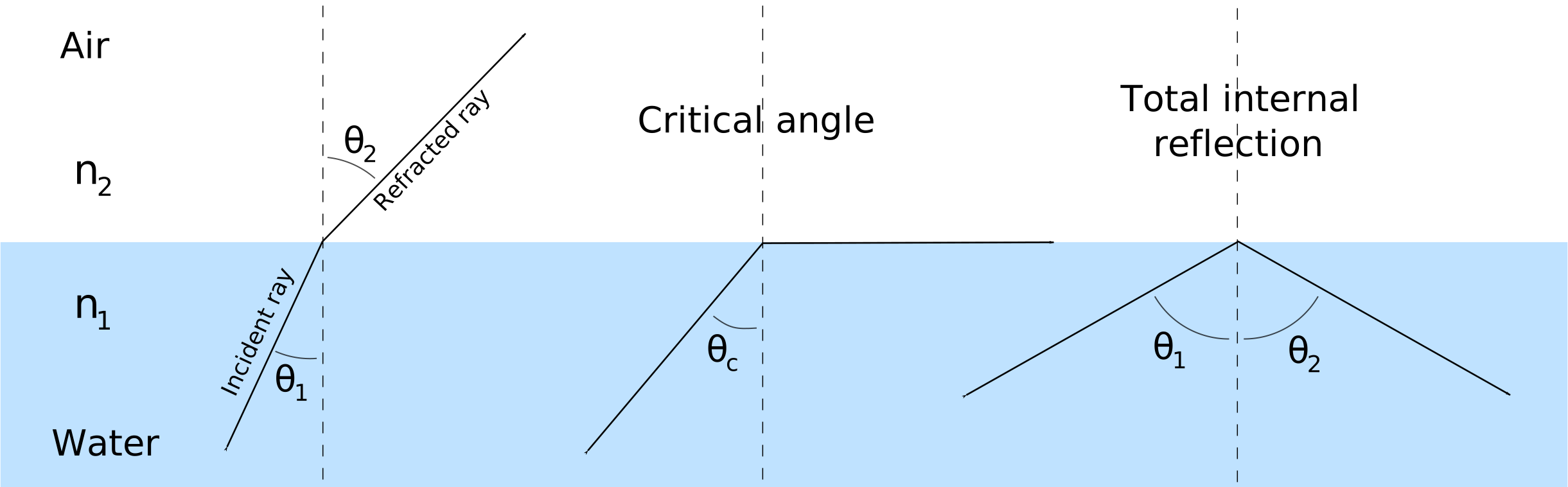
Fig ane: Refraction of light at the interface betwixt two media, including total internal reflection.
Optical Fiber
Full internal reflection is a powerful tool since it tin can be used to confine lite. One of the nearly common applications of total internal reflection is in fibre optics. An optical fibre is a sparse, transparent fibre, commonly made of glass or plastic, for transmitting light. The construction of a unmarried optical fibre is shown in.
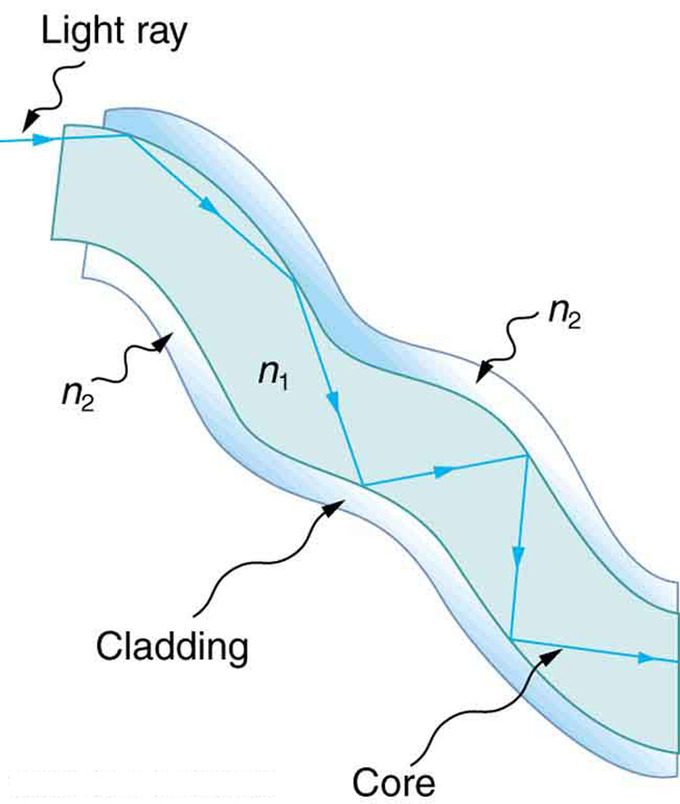
Fig 2: Fibers in bundles are clad by a material that has a lower index of refraction than the core to ensure total internal reflection, fifty-fifty when fibers are in contact with one another. This shows a single fiber with its cladding.
The basic functional structure of an optical fiber consists of an outer protective cladding and an inner cadre through which lite pulses travel. The overall bore of the fiber is about 125 μm and that of the cadre is simply virtually 50 μm. The difference in refractive index of the cladding and the core allows total internal reflection in the same fashion as happens at an air-h2o surface show in. If low-cal is incident on a cable stop with an angle of incidence greater than the critical angle and then the lite will remain trapped inside the drinking glass strand. In this way, low-cal travels very quickly downward the length of the cable over a very long altitude (tens of kilometers). Optical fibers are normally used in telecommunication, because information can be transported over long distances, with minimal loss of data. Another common use tin can be institute in medicine in endoscopes. The field of applied science and engineering concerned with the design and application of optical fibers are called fiber optics.
Full Polarization
Brewster's angle is an bending of incidence at which light with a detail polarization is perfectly transmitted through a surface.
Learning Objectives
Summate the Brewster's angle from the indices of refraction and hash out its physical mechanism
Cardinal Takeaways
Key Points
- When light hits a surface at a Brewster bending, reflected beam is linearly polarized.
- The physical mechanism for the Brewster's bending tin can be qualitatively understood from the manner in which electric dipoles in the media respond to p-polarized light.
- Brewsters' angle is given every bit [latex]\theta_\mathrm {\text{B}} = \arctan {\left( \frac{\text{n}_2}{\text{n}_1} \right)}[/latex].
Key Terms
- dipole: A separation of positive and negative charges.
- dielectric: An electrically insulating or nonconducting material considered for its electrical susceptibility (i.e., its property of polarization when exposed to an external electric field).
- polarizer: An optical filter that passes light of a specific polarization and blocks waves of other polarizations.
Brewster's bending (also known equally the polarization bending) is an angle of incidence at which lite with a detail polarization is perfectly transmitted through a transparent dielectric surface, with no reflection. When unpolarized light is incident at this angle, the light that is reflected from the surface is therefore perfectly polarized. This special angle of incidence is named afterward the Scottish physicist Sir David Brewster (1781–1868).
The physical mechanism for this can be qualitatively understood from the mode in which electric dipoles in the media respond to p-polarized light (whose electrical field is polarized in the aforementioned plane every bit the incident ray and the surface normal). One can imagine that light incident on the surface is absorbed, and then re-radiated by oscillating electric dipoles at the interface between the two media. The refracted low-cal is emitted perpendicular to the management of the dipole moment; no energy can be radiated in the direction of the dipole moment. Thus, if the bending of reflection θ1 (angle of reflection) is equal to the alignment of the dipoles (xc – θ2), where θ2 is angle of refraction, no low-cal is reflected.
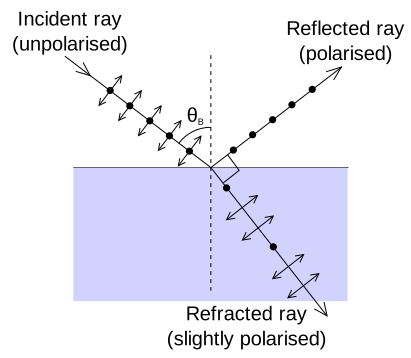
Fig 1: An illustration of the polarization of light that is incident on an interface at Brewster's angle.
This geometric condition can be expressed equally [latex]\theta_1 + \theta_2 = ninety ^{\circ}[/latex], where θane is the angle of incidence and θtwo is the angle of refraction. Using Snell's law (north1sinθ1 = n2sinθ2), one can calculate the incident angle θ1 = B at which no light is reflected: [latex]\text{n}_1 \sin {\left( \theta_\mathrm {\text{B}} \right)} =\text{n}_2 \sin {\left( 90^\circ - \theta_\mathrm {\text{B}} \right)}=\text{due north}_2 \cos {\left( \theta_\mathrm {\text{B}} \right)}.[/latex]Solving for θB gives [latex]\theta_\mathrm {\text{B}} = \arctan {\left( \frac{\text{northward}_2}{\text{n}_1} \right)}.[/latex]
When light hits a surface at a Brewster bending, reflected beam is linearly polarized. shows an instance, where the reflected beam was nearly perfectly polarized and hence, blocked past a polarizer on the right picture. Polarized sunglasses use the same principle to reduce glare from the dominicus reflecting off horizontal surfaces such equally h2o or road.
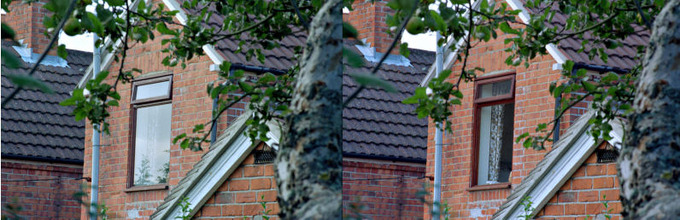
Fig ii: Photograph taken of a window with a camera polarizer filter rotated to 2 unlike angles. In the motion picture at left, the polarizer is aligned with the polarization bending of the window reflection. In the moving picture at right, the polarizer has been rotated 90° eliminating the heavily polarized reflected sunlight.
Dispersion: Rainbows and Prisims
Dispersion is defined as the spreading of white low-cal into its full spectrum of wavelengths.
Learning Objectives
Draw production of rainbows by a combination of refraction and reflection processes
Key Takeaways
Fundamental Points
- Dispersion occurs whenever in that location is a process that changes the direction of light in a mode that depends on wavelength. Dispersion can occur for whatsoever type of wave and e'er involves wavelength-dependent processes.
- For a given medium, n increases as wavelength decreases and is greatest for violet light. Thus violet light is bent more than red light, equally tin be seen with a prism.
- In a rainbow, light enters a drop of water and is reflected from the dorsum of the drop. The light is refracted both as it enters and as it leaves the drop.
Key Terms
- refraction: Changing of a light ray'south direction when it passes through variations in matter.
We run into about vi colors in a rainbow—red, orange, xanthous, greenish, blueish, and violet; sometimes indigo is listed, too. These colors are associated with different wavelengths of light. White light, in item, is a fairly compatible mixture of all visible wavelengths. Sunlight, considered to exist white, actually appears to be a chip yellow because of its mixture of wavelengths, but information technology does contain all visible wavelengths. The sequence of colors in rainbows is the same sequence as the colors plotted versus wavelength. What this implies is that white calorie-free is spread out co-ordinate to wavelength in a rainbow. Dispersion is defined as the spreading of white light into its total spectrum of wavelengths. More technically, dispersion occurs whenever there is a procedure that changes the direction of light in a mode that depends on wavelength. Dispersion, equally a general phenomenon, can occur for any blazon of wave and always involves wavelength-dependent processes.
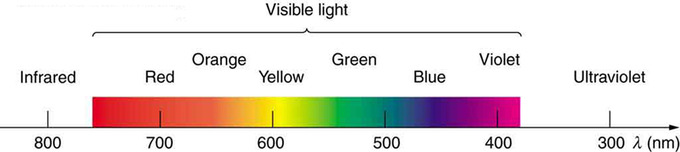
Colors of a Rainbow: Even though rainbows are associated with seven colors, the rainbow is a continuous distribution of colors according to wavelengths.
Refraction is responsible for dispersion in rainbows and many other situations. The angle of refraction depends on the index of refraction, as we saw in the Law of Refraction. We know that the index of refraction n depends on the medium. But for a given medium, n also depends on wavelength. Note that, for a given medium, n increases equally wavelength decreases and is greatest for violet light. Thus violet lite is bent more than scarlet light and the light is dispersed into the aforementioned sequence of wavelengths.
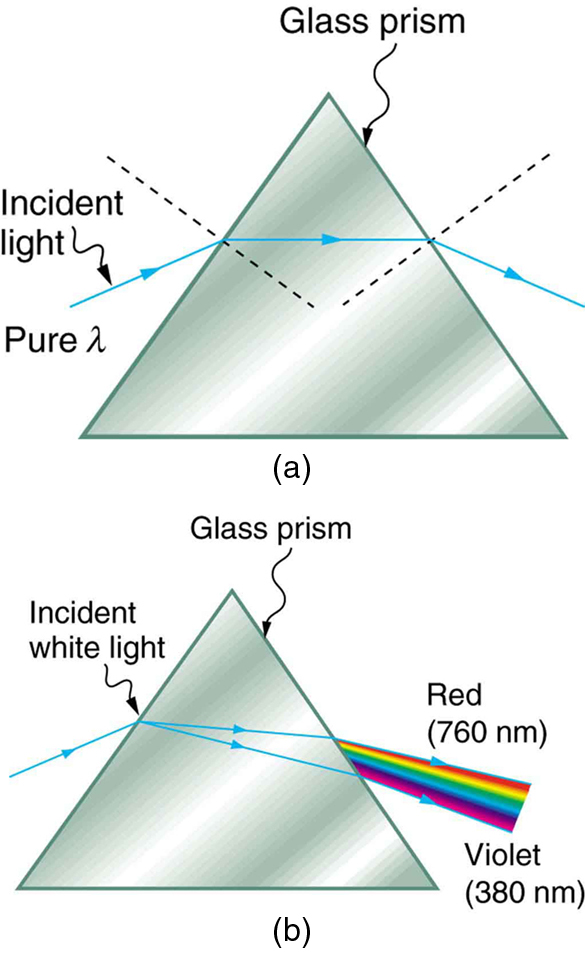
Pure Lite and Light Dispersion: (a) A pure wavelength of light falls onto a prism and is refracted at both surfaces. (b) White light is dispersed by the prism (shown exaggerated). Since the alphabetize of refraction varies with wavelength, the angles of refraction vary with wavelength. A sequence of ruby to violet is produced, because the index of refraction increases steadily with decreasing wavelength.
Rainbows are produced by a combination of refraction and reflection. You may have noticed that you lot see a rainbow simply when you look away from the lord's day. Light enters a drib of water and is reflected from the back of the drop. The low-cal is refracted both as information technology enters and every bit it leaves the drop. Since the index of refraction of water varies with wavelength, the light is dispersed, and a rainbow is observed. (In that location is no dispersion caused by reflection at the back surface, since the constabulary of reflection does not depend on wavelength. ) The actual rainbow of colors seen past an observer depends on the myriad of rays being refracted and reflected toward the observer's eyes from numerous drops of water. The arc of a rainbow comes from the need to exist looking at a specific angle relative to the direction of the sun.
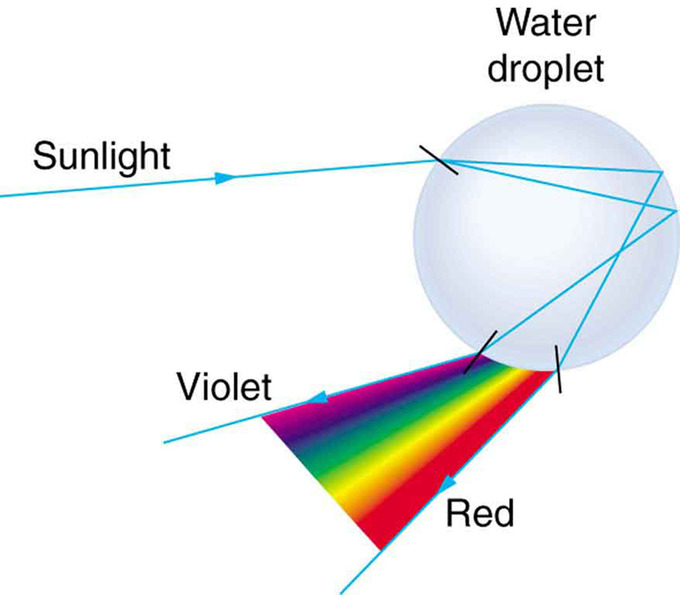
Light Reflecting on Water Droplet: Part of the calorie-free falling on this water drop enters and is reflected from the back of the drop. This low-cal is refracted and dispersed both as it enters and as it leaves the drop.
colemanhtiquous1960.blogspot.com
Source: https://courses.lumenlearning.com/boundless-physics/chapter/reflection-refraction-and-dispersion/
0 Response to "What Happens to the Reflected and Refracted Rays as You Change the Angle of the Incident Light Beam?"
Post a Comment